
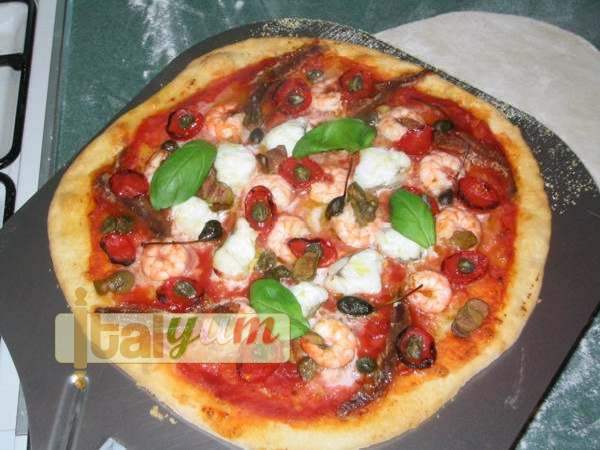
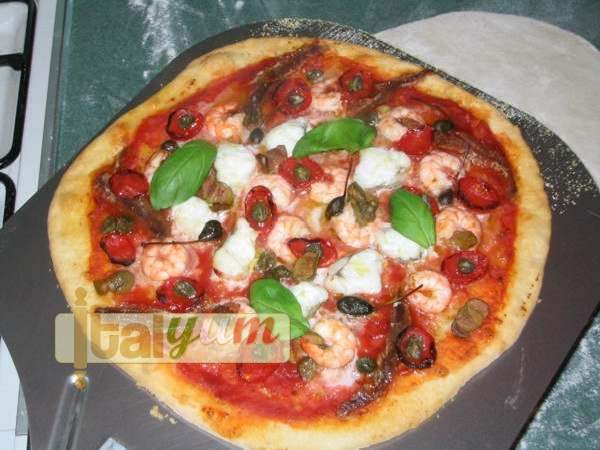
My seafood pizza
Dough preparation and rising: see the other pizza recipes in the websiteMaking the pizza base and topping it: about 5 minsCooking: 7-8 minsDifficulty: MediumRecently, many people have written to me and asked for more information on how to make a good home made pizza. In the past, I published an extensive step by step recipe for making pizza and I believe that recipe is still fundamental for those who are trying to make pizza for the first time or for those home cooks, with a bit more experience, who want to achieve a decent, thin and crispy result. At home, it is very difficult to replicate the same pizza you may have tasted in Italy, from a professional “pizzaiolo” (the pizza master) who used a wood burning oven for example (these ovens can achieve 450°C – 850°F temperature) and purposely selected pizza flour, but we can get very close to it if we follow some simple rules and apply some little tricks. Here, I give a list of things you should know before you attempt to make any pizza. This information is the result of years of experimenting to make pizza at home and from the many chats I had in Italy with the real professionals of the pizza.FLOURIn Italy, most of the pizza professionals use “00” flour, despite in the recent years there has been an increase in the use of purposely milled “0” flours. The term “00” type, or “0” or “1” is the Italian way to classify a flour and define its specific use. This classification gives you an idea of the ash content and protein content of the flour, see the chart below:The “00” flour is a very fine flour (50% extraction rate), however, there are many different “00” flours in the Italian market. More or less any flour mill in Italy makes an endless variety of “00” flours, to suit specific uses. So, how do we pick the right flour? In Italy, those who really aim for pizza excellence (especially the professionals of course) look for the W value (the flour strength) and the P/L ratio. If you want to know more about W and P/L, I have found this link very useful:http://www.theartisan.net/flour_criteria_judging.htmNow, as a general guidance to make pizza at home, use an Italian “00” type flour made from soft wheat, with a W value between 180 and 260, P/L ratio around 0.5 and a protein content between 10% and 12%.Here, I am giving you an example of an Italian flour mill milling four types of “00” flour for pizza:http://www.dallagiovanna.it/pizzas.html#menuSo, the next time you buy a “00” flour at the supermarket, remember that not all the “00” flours are the same. At the same time, in those countries where the flour is classified as soft, plain, strong and very strong, I suggest using plain flour (72% extraction rate) with protein content between 10% and 11% ( which is very close to the Italian “0” type). Strong and very strong flours are more appropriate for traditional bread making because of their higher protein content and I wouldn’t use them unless I have additional information like W, P/L, type of wheat (soft or hard) and extraction rate.MAKING THE DOUGHUse flour, water, yeast and a bit of olive oil. The ideal temperature for the pizza dough should be 22°C (73°F). Dough temperature is influenced by the water temperature, the flour temperature and the ambient temperature, so here is the formula to work out the water temperature you need to prepare the dough:Water temp. = Dough temp. x3 – (Ambient temp. + Flour temp.)RAISING TIMEMost pizzerias prepare the dough in the morning, to be used in the evening. You can raise the dough for two hours if you are in a hurry but if you want the dough to develop flavour and texture, then you need longer fermentation time – let nature to do its job!PIZZA BASE (dough weight)When making the pizza base use a dough ball of roughly 180-200 g weight. This quantity is ideal for making a 30 cm (12") pizza base.PIZZA BASE (thickness)A traditional pizza base has to be very thin, to achieve quick cooking and a crispy finish. Remember, a thick pizza base, in a very hot oven, would require a longer time to cook and this could result in the burning of the topping.TOMATO SAUCEThe best tomato base to use is “passatta di pomodoro”. To the passata, you can add some oregano and a splash of olive oil, if you want. Use a couple of tablespoons for a very large pizza and spread thinly to colour the base.OVEN TEMPERATUREIf using a wood oven, the oven temperature should be between 350°C (650°F) and 400°C (750°F) and the cooking time should be 1-3 minutes.If using a professional electric oven, the oven temperature should be between 280°C (550°F) and 320°C (600°F) and cooking time should be 3-4 minutes.If using a home cooker oven, we know that we can rarely go above 240°C (465°F), so set the oven to this maximum temperature and cook for about 7-10 minutes. Always pre-heat the oven, to ensure baking the pizza straightaway at the right temperature.The above times and temperatures can be affected by many factors, especially at home (i.e. temperature drops considerably is you open the oven door frequently or a conventional oven works differently from a fan assisted oven etc.).


Italian Apron


Serving bottles


Classic Italian Cooking
Clicking on equipment pictures takes you to Amazon where you can buy the items. We get a small revenue share of anything you buy which helps keep the site running.
Ingredients
For my seafood pizza topping I used the following ingredients:
- 1 Monkfish tail
- Tiger prawns
- Green olives (stoned)
- Caper berries
- Tomato passata
- Fresh basil leaves
- Small plum or cherry tomatoes (dried) For the pizza dough, check the other pizza recipes in the website.
- Polenta or coarse semolina flour (this is for the pizza peel)
Instructions
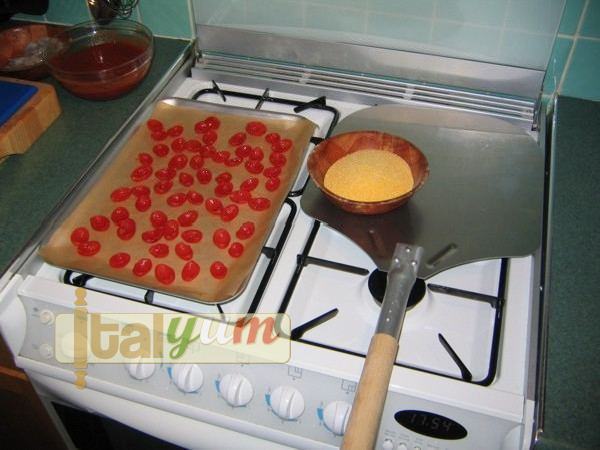
- When making pizza, you should avoid topping the pizza with fresh tomatoes because of their high juice content, that would inevitably make the pizza base soggy. The trick is to dry the tomato first.Dry some little plum/cherry tomatoes in the oven. To do so, cut them in half, scoop the seeds out, lay the tomatoes onto a baking paper and dry them in the oven. The oven should be set at its lowest (around 100°C – 212°F) and the process should take a couple of hours. The tomatoes should not be completely dry; they should just retain a slight juiciness without risking the soaking of the pizza base.
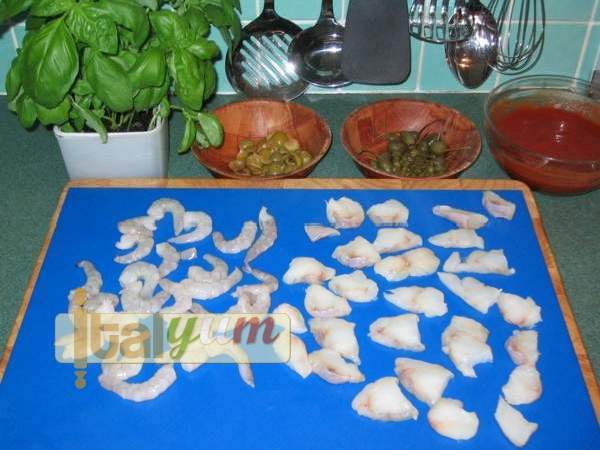
- First and foremost, before you start, pre-heat the oven. Then, cut the monkfish tail into small pieces. Pat all the fish dry using kitchen paper.
- Sprinkle some polenta or coarse semolina flour onto the pizza peel. This will make the pizza disc slipping onto the pizza stone easier.
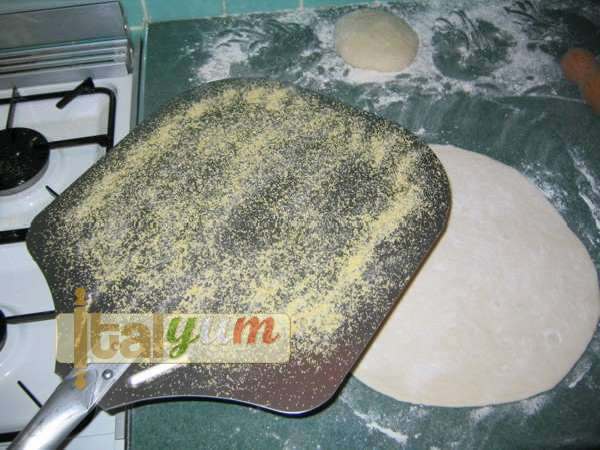
- Make the pizza base and dust the side that will be in contact with the pizza peel with a generous amount of flour.
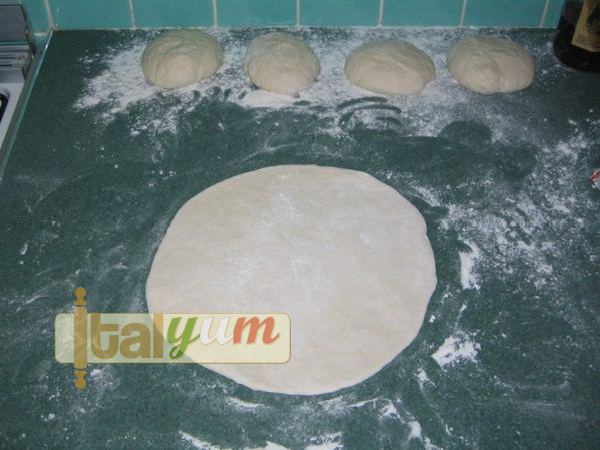
- Move the pizza base onto the peel. I suggest doing it at this stage, when the base is not loaded with all the ingredients (if the pizza dough is too soft and sticky, you will have problem putting it onto the peel if loaded with the ingredients).
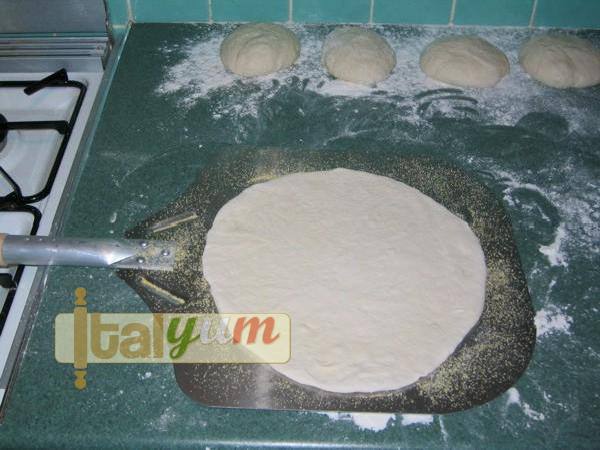
- Now, quickly spread the tomato sauce.
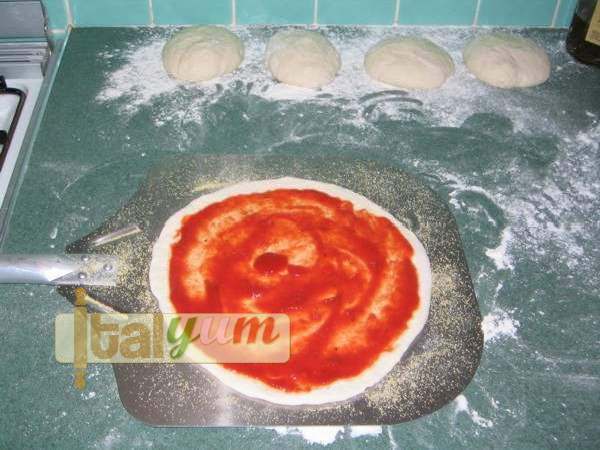
- Top the pizza base with the ingredients available.
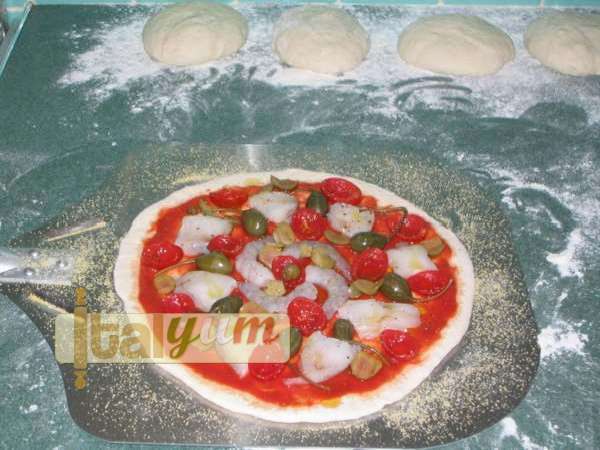
- A final dash with olive oil all over the pizza. The picture shows the seafood pizza ready to be baked.
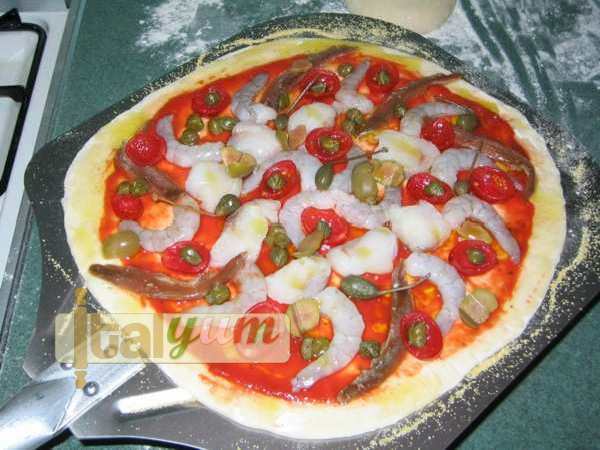
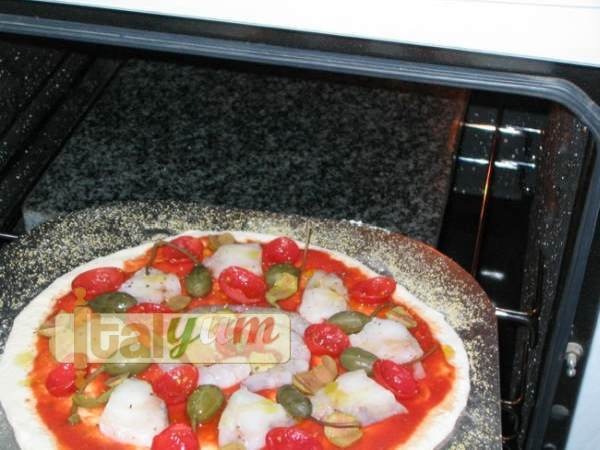
- Quickly open the oven and let the pizza slip onto the hot stone.
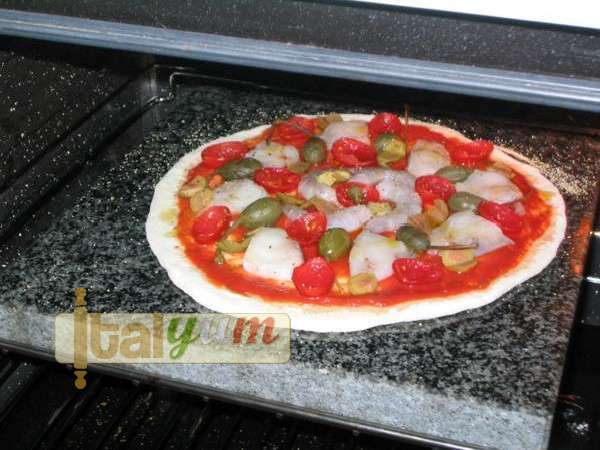
- And now bake for 7-8 minutes (this would apply for an electric fan assisted oven set to 230°C – 450°F) until the base looks golden in colour and achieve a crispy texture.
- Seafood pizza ready.
Italian Apron
Serving bottles
Classic Italian Cooking
Nutrition
Calories: 650kcal
Tried this recipe?Let us know how it was!
